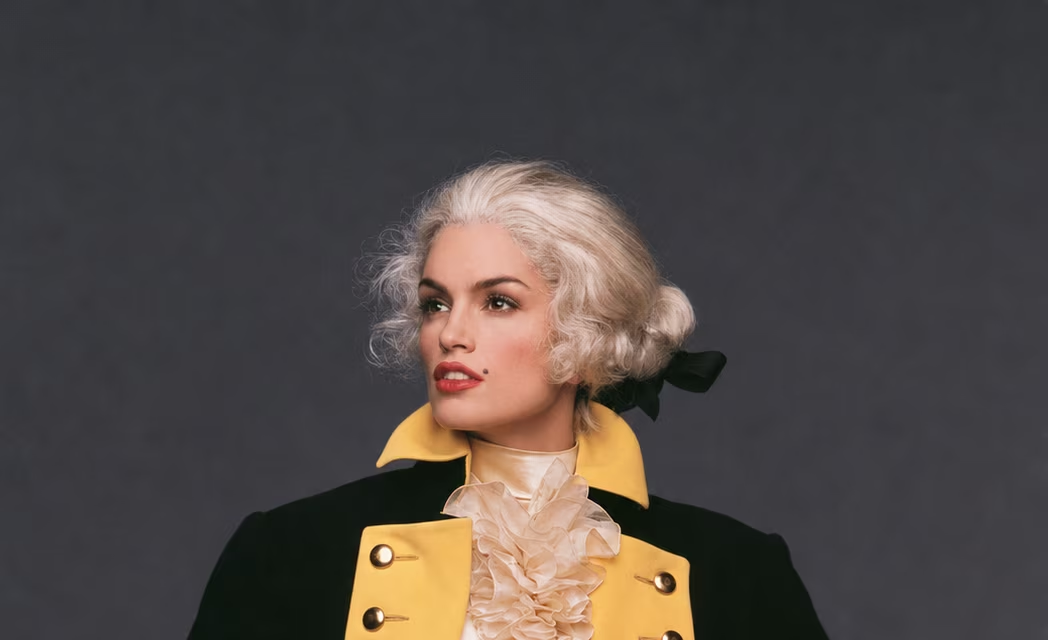
George was an American political and lifestyle magazine published from 1995 to 2001 by Hachette Filipacchi Magazines. †1 †2 John F. Kennedy Jr. and public relations executive Michael J. Berman founded George through their company Random Ventures as a 50-50 joint venture with Hachette Filipacchi Magazines. †3 †4 †5 They unveiled the inaugural October/November 1995 issue on September 7, 1995, at Federal Hall in New York City. †6 †1 With the tagline "Not Just Politics as Usual," George covered American politics alongside celebrity interviews, fashion advertising, and popular culture. †7 †8 †4 †9
After launching on an every-two-months schedule, George expanded to monthly publication before shifting to 10 issues a year in 2000. †1 †5 †10 Following Kennedy's death in a plane crash on July 16, 1999, Hachette Filipacchi Magazines acquired the Kennedy estate's 50 percent stake in October 1999 and appointed Frank Lalli, hired from Money, as editor-in-chief on November 29, 1999. †11 †12 Advertising revenue continued to decline, and Hachette Filipacchi Magazines closed George with the March 2001 farewell issue. †1 †13
History
John F. Kennedy Jr. and Michael J. Berman originally formed Random Ventures in the late 1980s to market custom kayaks and revived Random Ventures after Bill Clinton's 1992 presidential campaign inspired Kennedy to plan a political magazine. †4 After failing to raise $10 million from private investors for a mid-scale title with prospective names such as Politicos or New Agenda, Kennedy and Berman partnered with Hachette Filipacchi Magazines under chief executive David J. Pecker, who committed $20 million to launch George as a glossy lifestyle magazine in a 50-50 joint venture with Random Ventures. †4 †5 In April 1995, Kennedy promoted George at the Adcraft Club in Detroit before an audience of 1,900 ticket holders, where General Motors committed to become George's largest advertiser. †4
On September 7, 1995, Kennedy as editor-in-chief, Berman, and Pecker unveiled the inaugural October/November 1995 issue of George at a press conference in the rotunda of Federal Hall in New York City, with 500,000 copies scheduled for distribution beginning September 26. †6 †1 In January 1996, editor Eric Etheridge left George after two issues over editorial differences with Kennedy. †3 †7 Kennedy assumed Etheridge's hands-on editorial duties and promoted senior editor Elizabeth Mitchell, formerly of Spin, to the newly created post of executive editor. †3 †7
George began on an every-two-months schedule, and in August 1996 Los Angeles Times reported that advertising volume supported an expansion from six to 12 issues a year as George reached its first anniversary in September 1996. †6 †4 By February 1997, George carried single-month cover dates and referred to "this month's survival guide" in its editor's letter, though the Library of Congress catalog record lists George as appearing every two months from 1995 to 1997 and monthly from 1998 to 2001. †8 †14 †1 Tensions between Kennedy and executive publisher Michael J. Berman escalated into a physical confrontation in George's New York offices in March 1997, and Berman transferred to another division of Hachette Filipacchi Magazines in mid-1997. †9 †7 Launch publisher Elinore Carmody was replaced around early 1998. †7
After The New Republic fired associate editor Stephen Glass for fabricating articles in May 1998, senior editor Richard Blow audited Glass's freelance submissions for George, killed an unpublished profile of writer John Podhoretz, dismissed Glass, and prepared an apology for fabricated anonymous sources in Glass's April 1998 profile of Washington lawyer Vernon E. Jordan Jr. †15 †16 Following declining advertising pages in 1998 and a January 6, 1999 New York Post report that Hachette Filipacchi Magazines was pressuring Kennedy to hire new leadership, executive editor Elizabeth Mitchell resigned on January 7, 1999. †7 On January 8, 1999, Kennedy promoted senior editor Richard Blow to executive editor as associate publisher Deborah Marcogliese and creative services director Negi Vafa also left George. †7
By mid-1999, Hachette Filipacchi Magazines was weighing whether to end George when the Random Ventures publishing contract expired at year-end, and Kennedy had begun meeting prospective new financial partners. †17 †5 On July 16, 1999, Kennedy, his wife Carolyn Bessette-Kennedy, and her sister Lauren Bessette died when the private plane Kennedy was piloting crashed off Martha's Vineyard, Massachusetts. †11 †2 On July 19, 1999, Hachette Filipacchi Magazines president and chief executive Jack Kliger stated that Hachette Filipacchi Magazines remained committed to continuing George. †17 Executive editor Richard Blow ran George on an interim basis after the crash and dismissed writers Lisa DePaulo and Douglas Brinkley after they spoke to outside reporters about Kennedy. †18
In September 1999, Hachette Filipacchi Magazines printed 1 million copies of an October 1999 tribute issue to Kennedy and conditioned its continued backing on acquiring majority ownership from the Kennedy estate. †5 Hachette Filipacchi Magazines acquired the 50 percent stake in George inherited by Caroline Kennedy in October 1999. †11 On November 29, 1999, Hachette Filipacchi Magazines announced the appointment of Frank Lalli, hired from Money, as editor-in-chief, and Blow departed George. †11 †12 †18 After announcing plans in September 1999 to reduce frequency starting in February 2000, Hachette Filipacchi Magazines published George 10 times a year in 2000, including combined issues such as the February/March 2000 edition. †5 †10 On January 4, 2001, Hachette Filipacchi Magazines announced that George would cease publication in March 2001, a decision that affected about 40 staff members; Kliger praised Lalli's editorial product but cited a softening advertising market and insufficient advertiser support. †13 †2 The final issue, Vol. 6, No. 1 (March 2001), was designated the Farewell issue and honored Kennedy with a tribute and interviews he had conducted. †1 †13 †19
In 2022, photographer Gene Ho and managing editor Dave Blaze launched an unrelated conservative online and print publication under the George name and logo without confirmed authorization from Hearst, which had acquired Hachette's U.S. magazine assets in 2011, or from the Kennedy family. †20 †10
Publishing history timeline
-
Inaugural issue unveiled
September 7, 1995John F. Kennedy Jr., Michael J. Berman, and Hachette Filipacchi Magazines unveiled the October/November 1995 debut issue of George at Federal Hall in New York City.
-
First editor departure
January 1996Editor Eric Etheridge left after two issues over editorial differences with John F. Kennedy Jr., and Elizabeth Mitchell became executive editor.
-
Co-founder transfer
Mid-1997Co-founder and executive publisher Michael J. Berman transferred to another division of Hachette Filipacchi Magazines after clashes with John F. Kennedy Jr.
-
Executive editor transition
January 1999Elizabeth Mitchell resigned on January 7 amid declining advertising pages, and John F. Kennedy Jr. promoted Richard Blow to executive editor on January 8.
-
Death of John F. Kennedy Jr.
July 16, 1999Founding editor-in-chief John F. Kennedy Jr. died in a plane crash off Martha's Vineyard, Massachusetts.
-
Hachette buyout
October 1999Hachette Filipacchi Magazines acquired the 50 percent stake in George inherited by Caroline Kennedy.
-
Appointment of Frank Lalli
November 29, 1999Hachette Filipacchi Magazines appointed Frank Lalli, hired from Money, as editor-in-chief, and executive editor Richard Blow departed.
-
Schedule reduced to 10 issues a year
2000Hachette Filipacchi Magazines shifted George from a monthly schedule to 10 issues a year, including combined issues such as the February/March 2000 edition.
-
Closure announced
January 4, 2001Hachette Filipacchi Magazines announced that George would cease publication in March, a decision that affected about 40 staff members.
-
Final issue
March 2001Hachette Filipacchi Magazines published Vol. 6, No. 1 (March 2001) as the Farewell issue of George.
Editorial profile and coverage
George treated American politics as part of popular culture rather than policy analysis, looking visually to Elle, Mirabella, Vanity Fair, and Esquire while adopting a self-described post-partisan editorial stance. †4 †9 In his October 1995 editor's letter, Kennedy defined George as "a lifestyle magazine with politics at its core, illuminating the points where politics converges with business, media, entertainment, fashion, art and science." †9 Kennedy also compared the concept to Rolling Stone and People for readers interested in politics, targeting college-educated adults ages 25 to 49 outside Washington, D.C. †4 †9
Early covers placed actors and models in historical or political costumes, opening with supermodel Cindy Crawford dressed as George Washington on the October/November 1995 cover and continuing with George Clooney in a powdered wig, Harrison Ford in Abraham Lincoln attire, and Drew Barrymore evoking Marilyn Monroe. †6 †21 By August 1996, George's editors dropped the historical-costume formula in favor of contemporary celebrity shoots, including covers with Demi Moore, Julia Roberts, and a shirtless Woody Harrelson. †4 †9 Of the 42 issues published during Kennedy's lifetime, only three put political figures on the cover. †21 Later issues under Lalli occasionally paired political or historical hooks with celebrity covers, placing Donald Trump on the February/March 2000 cover ("The Secret Behind Trump's Political Fling") and Mel Gibson in colonial garb on the July 2000 cover alongside Gibson's film The Patriot. †10 †12
The 280-page inaugural issue mixed Kennedy's interview with former Alabama governor George Wallace, an essay by novelist Caleb Carr, a report on Time Warner and gangsta rap, a fashion dialogue between Cindy Crawford and Isaac Mizrahi, and Madonna writing in the recurring back-page column "If I Were President." †6 †4 "If I Were President," which also appeared in Dateline NBC television segments by 1996, solicited brief policy and personal musings from entertainers including Madonna and Gloria Estefan. †4 Kennedy opened issues with a signed "Editor's Letter" and conducted Q&A interviews with political, media, and business figures including Wallace, actor Warren Beatty, New Jersey governor Christine Todd Whitman, National Rifle Association president Marion Hammer, National Enquirer editor emeritus Iain Calder, conservative philanthropist Richard Mellon Scaife, and radio host Don Imus. †4 †17
The inspected February 1997 issue ("Survival Guide to the Future"), priced at $2.95 in the United States, $3.95 in Canada, and £2.50 in the United Kingdom, opened with Kennedy's "Editor's Letter" ("Oh! Say Can You See...") and included Kennedy's Q&A interview with Microsoft chairman Bill Gates ("Bill Gates of Mouse & Man"), historical and fiscal essays by Douglas Brinkley and Peter Lynch with Peter G. Peterson, and a multi-part package titled "Platform 2020: A Survival Guide to the Future" ("A Nation's Future Foretold"). †8 †14 †22 †23 That package paired "Now" and "2020" essays on transportation by Jake Tapper, the environment by Brad Wetzler, education by Richard J. Murnane and Frank Levy, crime by James Neff, infectious disease by Arno Karlen, sex and drugs by Melissa Roth, warfare by Holly Yeager, and food by Michelle Stacey, alongside recurring "On the Cutting Edge" profile boxes and "Factoids" sidebars. †24 Across 1996 to 2000, columnists and contributors spanned partisan lines, including Paul Begala, Arthur Schlesinger Jr., Alfonse D'Amato, Phyllis Schlafly, David Brock, Tony Blankley, Claire Shipman, Lisa DePaulo, Ann Coulter, Mark Leyner, and Bret Easton Ellis. †4 †7 †17 †21 †10
Under Lalli in July 2000, George combined election commentary from rock band Pearl Jam with a "New Patriots" gallery profiling Patti Smith, Aaron Sorkin, Erin Brockovich, Russell Simmons, and Don Imus, and kept Kennedy's name on the masthead as founding editor alongside a full-page photograph of him on the anniversary of his death. †12 Online, an April 1999 capture of www.georgemag.com directed visitors exclusively to America Online at "Keyword: George" alongside links to sibling Hachette Filipacchi magazines Premiere, Car and Driver, and Elle. †25
Readership, circulation, and business model
Hachette Filipacchi Magazines committed $20 million to George under a 50-50 joint venture with Random Ventures and initially projected profitability in five years, although chief executive David J. Pecker told The New York Times in January 1996 that Hachette Filipacchi Magazines hoped to break even in year three and The Independent reported a four-year projection in 1997. †4 †9 †7 Hachette Filipacchi Magazines required a two-issue commitment from early advertisers, and George carried 175 advertising pages in its inaugural issue and 350 across its first two issues; luxury fashion and automotive advertisers included General Motors, Chrysler, Armani, DKNY, Polo Ralph Lauren, Tanqueray, and Louis Vuitton. †6 †4 †9 Advertising volume fell to 60 pages by August 1996, averaged 75 pages in early 1997, dropped 5.21 percent through November 1998 compared with 1997 (with December 1998 down 20 percent year-over-year according to Media Industry Newsletter), and fell 30 percent in pages and 20 percent in revenue in the first half of 1999 according to the Publishers Information Bureau. †4 †9 †7 †17
For readership demographics in 1996, co-founder Michael J. Berman stated that George's audience was 55 percent women, while City Journal reported in 2019 that by 1996 the average reader was 36 years old with a median household income of $65,000, over 90 percent college-educated, and 60 percent female. †4 †21 The inaugural issue sold 500,000 copies according to Time in January 1996, whereas City Journal later reported that 97 percent of a 550,000-copy newsstand run sold. †3 †21 Before Audit Bureau of Circulations audits began, Berman reported mid-1996 circulation at 180,000 paid subscriptions and 300,000 newsstand sales. †4
| Period | Metric | Figure | Source |
|---|---|---|---|
| 1997 | Average paid circulation (ABC) | 412,192 | Los Angeles Times (2000) †12 |
| July–December 1998 | Average paid circulation (ABC) | 403,894 | Los Angeles Times (2000) †12 |
| July–December 1998 | Newsstand single-copy sales (ABC) | 90,867 | Los Angeles Times (1999) †5 |
| July–December 1999 | Average paid circulation (ABC) | 558,549 | Los Angeles Times (2000) †12 |
Single-copy newsstand sales surged immediately after Kennedy's death—reaching 185,500 copies in July 1999, 318,000 in August 1999, 235,000 in September 1999, and 395,000 in October 1999 out of a 1 million copy print run—before falling to 110,000 copies in both November and December 1999. †5 †12 In September 1999, Hachette Filipacchi Magazines cut the annual subscription rate from $17.76 to $9.97 and raised its guaranteed paid rate base from 400,000 to 450,000 starting in February 2000. †5 Under Lalli, circulation grew by nearly 25 percent in 2000, and Reuters reported circulation at 500,000 when Hachette Filipacchi Magazines announced the closure in January 2001. †19 †2
Reception and impact
Reviews at launch split sharply across U.S. newspapers: The Philadelphia Inquirer called George "revolutionary fun" and the Detroit News praised George as "a political gem," whereas The Wall Street Journal dismissed its editorial content as "an afterthought" and The Boston Globe described George as "disappointingly vapid." †4 Folio editor Anne Russell questioned in September 1995 whether 500,000 readers wanted politicians on magazine covers, while Harper's publisher John R. MacArthur argued that Hachette Filipacchi Magazines over-hyped the launch instead of letting George start more modestly. †6 In 1996, New York founding editor Clay Felker criticized George as "a magazine without a function, with no point of view," and former White House adviser George Stephanopoulos called George harmless entertainment that might attract non-political readers while warning that turning politics into entertainment could widen distance between politicians and the public. †4 In 1997, New York University professor Lawrence White described George as "the smallest circulation entertainment magazine" and said George showed detachment from serious public affairs and an ill-defined niche. †9
After George's run, former executive editor Richard Blow drew criticism from former George colleagues in 2000 after selling a memoir proposal about working with Kennedy despite having dismissed writers who spoke to reporters after Kennedy's death and having signed a 1996 confidentiality agreement. †18 †12 In a 2019 assessment for City Journal, assistant editor Charles F. McElwee argued that George anticipated the merging of American politics and celebrity culture even though its post-partisan framing departed from the sharper ideological polarization that followed. †21
External links
- George Magazine Online (archived April 27, 1999)
- George — February 1997 partial issue scan
- Library of Congress catalog record
Citations
- George (New York, N.Y.) (Library of Congress catalog record). Library of Congress,
- Reuters.George Magazine to Cease Publishing in March.Los Angeles Times, 2001.
- TIME.Bye George!.Time, 1996.
- Nina J. Easton.Is John Kennedy Jr.'s 'George' making American politics sexy?.Los Angeles Times, 1996.
- Diane Seo.Hachette Affirms Commitment to George Magazine.Los Angeles Times, 1999.
- Geraldine Baum.George Takes a Bow : Magazines: John Kennedy Jr. launches his politics-through-culture magazine, while a competitor prepares to debut Sunday.Los Angeles Times, 1995.
- Carl Swanson.George Magazine Loses a "Yes" Woman As Hachette Steps In.Observer, 1999.
- George — February 1997 (front cover) (primary source).George, 1997.
- Daniel Jeffreys.JFK's trouble with George.The Independent, 1997.
- Stephanie Mencimer.JFK Jr.’s Iconic Magazine Is Back From the Dead. You Can Thank QAnon.Mother Jones, 2022.
- DER SPIEGEL."George": Kennedy-Nachfolger angetreten.Der Spiegel, 1999.
- Mary K. Feeney.Media Excess Continues on First Anniversary of JFK Jr.'s Death.Los Angeles Times, 2000.
- George magazine to fold in March. CNN, 2001.
- John F. Kennedy Jr..Oh! Say Can You See... (Editor's Letter, February 1997 issue) (primary source).George, 1997.
- Reuters.Magazine Apologizes for Fabricated Articles.Los Angeles Times, 1998.Referenced by: †15
- Richard Blow.Fool me once (primary source).Salon, 2003.Referenced by: †16
- The Washington Post.Fate of Political Magazine George Clouded Before Loss of JFK Jr.Los Angeles Times, 1999.
- Andrew Goldman.After He Muzzled George Editors, Blow Takes Heat for J.F.K. Jr. Book.Observer, 2000.
- Publishing Executive Staff.George Magazine Folds.Adweek, 2001.
- Lucas Ropek.QAnon Supporter Resurrects JFK Jr.'s Magazine George and Puts Trump's Face on the Cover.Gizmodo, 2022.Referenced by: †20
- Charles F. McElwee.JFK Jr.'s Accidental Legacy.City Journal, 2019.
- John F. Kennedy Jr..Bill Gates of Mouse & Man (February 1997 issue) (primary source).George, 1997.Referenced by: †22
- Platform 2020: A Survival Guide to the Future (February 1997 issue) (primary source).George, 1997.Referenced by: †23
- A Nation's Future Foretold (February 1997 issue) (primary source).George, pp. 70–76, 1997.Referenced by: †24
- George On-Line (archived April 27, 1999) (primary source). George, 1999.Referenced by: †25